If there's one amenity question we get more than any other from Vermont property owners, it's this one. And it's a good question, because a hot tub is one of the few property investments that has a clear, measurable impact on short-term rental income — not in theory, but in actual booking data.
We manage two properties near Stratton Mountain, both with hot tubs and saunas. We've also worked with owners who added a hot tub mid-way through their rental life and watched the numbers shift in real time. Here's what actually happens.
Hot Tubs Are the #1 Amenity Filter in Vermont STR Searches
This is not a guess — it's borne out by how guests actually use Airbnb and VRBO search. On Airbnb, "hot tub" is consistently one of the top amenity filters applied by Vermont vacation rental searchers. On VRBO, it's listed as a primary filter option on the search page itself.
What this means practically: if your property doesn't have a hot tub, a significant percentage of guests searching for Vermont properties near Stratton never see your listing at all. They've already filtered you out before comparing rates, photos, or reviews. In shoulder season especially — when overall inventory is high relative to demand — not having a hot tub means competing for a materially smaller pool of guests.
In ski season, the demand is broad enough that properties without hot tubs still book reasonably well. The hot tub premium in ski peak is primarily about rate, not occupancy. In April, October, and November, it's about occupancy too.
The Occupancy Impact: 40–60% Faster in Shoulder Season
When we compare booking velocity — how quickly dates fill after they open on the calendar — properties with hot tubs in shoulder season book significantly faster than comparable properties without. The difference we've observed is roughly 40–60% faster fill rates during October, November, April, and May.
To make that concrete: if a property without a hot tub fills its April calendar by mid-March, a similar property with a hot tub is likely filled by late February. That two-to-three week difference in booking lead time matters because it gives you better revenue visibility, reduces the pressure to discount last-minute, and often results in higher rates on the bookings that come in early.
Hot tub guests in shoulder season are also self-selecting. They're choosing your property specifically because of the hot tub — which means they're less likely to book and then complain that there's "nothing to do" in mud season. They came for the hot tub. They'll use it every night. They tend to leave strong reviews.
The Nightly Rate Premium: $30–50 on Average, More During Peak
Across the southern Vermont market, a property with a hot tub commands a premium over a directly comparable property without one. In our observation, that premium runs:
- Ski season weekends: $40–70/night above comparable properties without hot tubs
- Ski season midweek: $25–40/night premium
- Summer weekends: $30–50/night premium
- Shoulder season (spring/fall): $20–35/night premium (lower rate but bigger occupancy impact)
- Peak foliage weekends: $40–60/night premium
Average it across the full calendar at a realistic occupancy rate, and you're looking at an effective premium of $30–50/night on booked nights. On a property that runs 180 booked nights per year, that's $5,400–9,000 in additional annual revenue — just from the hot tub premium, before accounting for the occupancy improvement in shoulder months.
Add the occupancy improvement and the real total revenue impact on an active rental property is often $10,000–18,000 annually for a well-maintained hot tub in the Stratton corridor.
What Does a Hot Tub Cost to Install?
Quality varies significantly, and so does price. Here's the realistic range for a property hot tub installation in Vermont:
Entry-level portable spa (inflatable or basic plug-and-play): $1,500–3,500. These don't hold up well in Vermont winters, don't photograph well, and guests notice the quality difference. We'd generally steer away from these for a rental property — they create more maintenance issues than they solve and don't deliver the full amenity impact.
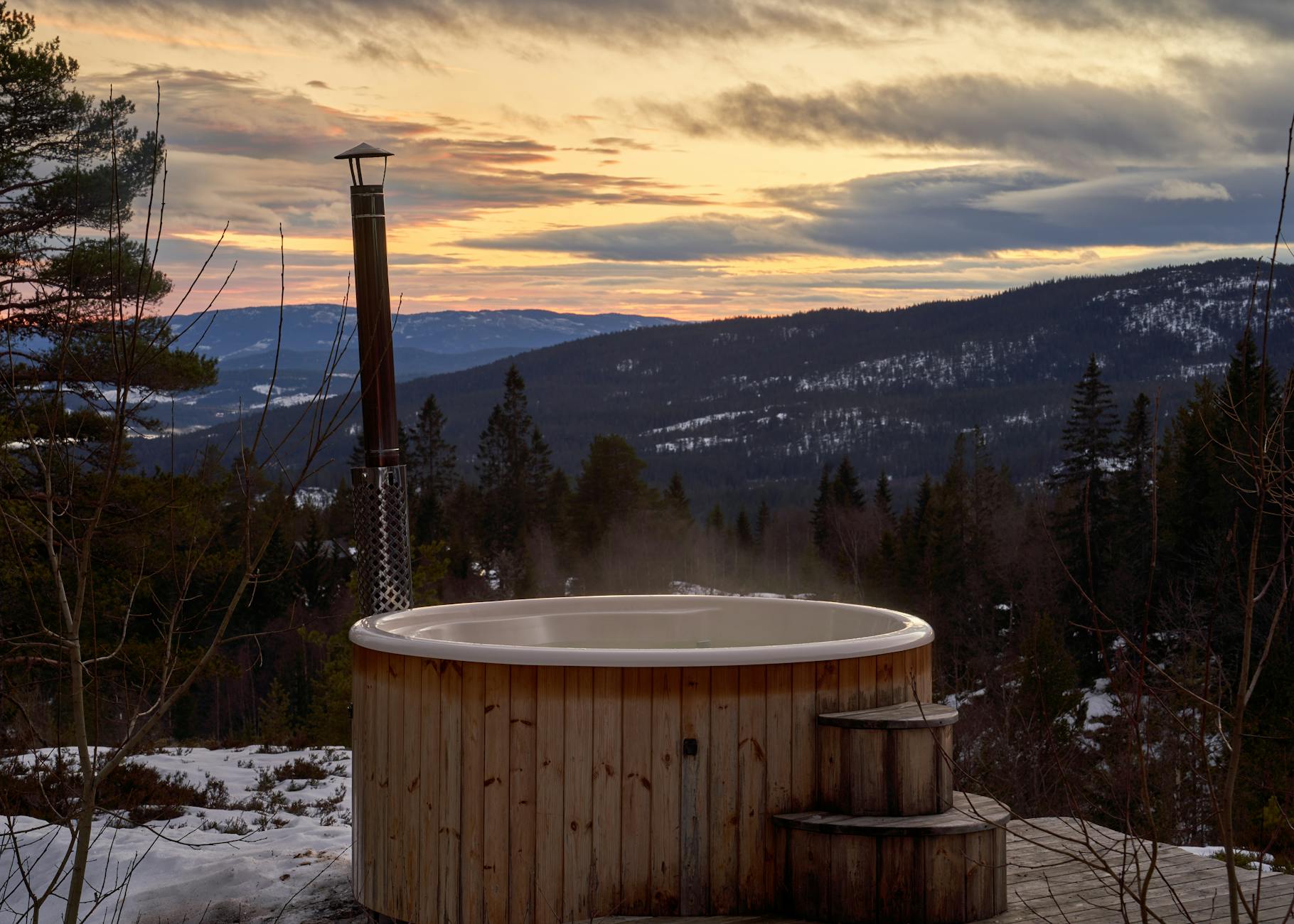
Mid-range hard-shell hot tub (Bullfrog, Hot Spring, Sundance): $6,000–10,000 for the unit. Add $1,500–3,000 for electrical panel upgrade (if needed), delivery, installation, and deck work. Total installed cost: $8,000–12,000 for most Vermont properties.
High-end / large capacity units (6–8 person, premium brands): $12,000–18,000 installed. Makes sense for a large luxury property where the amenity is a core marketing feature.
For most 3–5 bedroom Vermont rental properties, the mid-range segment is the right call. Guests can tell the difference between a quality hot tub and a cheap one, and the reviews will reflect it.
Payback Period: The Math Actually Works
At an installed cost of $9,000–12,000 and a revenue improvement of $10,000–18,000 annually, the payback period on a quality hot tub installation for an active Vermont rental property is typically 12–18 months.
That's a strong return on a capital investment by any measure. After year two, the incremental revenue is essentially pure upside.
The calculation works because Vermont's peak rates are high enough that even a modest nightly premium adds up quickly, and because the shoulder season occupancy improvement represents real revenue that otherwise wouldn't exist at all.
Ongoing Maintenance Costs: Be Realistic
A hot tub is not a set-and-forget investment. Budget accordingly.
Chemicals and supplies: $600–1,000/year for a well-used rental hot tub. Rental hot tubs get significantly more use than residential ones — budget on the higher end.
Annual professional service/inspection: $200–400/year. Worth doing, especially in Vermont where hard winters and freeze risk are real.
Filter replacement: $150–300 every 1–2 years depending on usage.
Cover replacement: $400–700 every 3–5 years. Covers take a beating in Vermont winters and from guest use.
Major repairs (pump, heater, jets): Budget $500–1,500 every 5–7 years for a quality unit that's well-maintained.
Total ongoing maintenance: roughly $1,000–1,500/year in a typical operating year. Factor that against the $10,000+ annual revenue premium and the net contribution is still very strong.
Liability and Insurance
Hot tubs do add liability exposure — slips, falls, and overuse incidents are the primary risks. Before installing, call your insurance carrier and make sure your policy covers a hot tub used in a commercial short-term rental context. Some standard homeowner policies exclude STR use entirely. You need a policy that's specifically written for rental use.
Practical steps: post clear rules (no glass, shower before entering, max occupancy), provide a basic safety card at the property, and consider a timed cover lock for late-night hours if you have noise-sensitive neighbors. Vermont's short-term rental landscape is still relatively light on regulation, but being proactive on liability protects both you and your guests.
What We See at Our Own Properties
Both properties we manage near Stratton — Whispering Pines Lodge and Stratton Chalet — have hot tubs and saunas. The sauna adds its own pull (it's a genuine differentiator that photographs exceptionally well and generates guest comments in reviews), but the hot tub is the primary driver in search filters and booking decisions.
Stratton Chalet, our 3-bedroom property starting from $202/night, books consistently through shoulder seasons in part because the hot tub keeps it relevant in the amenity filter results when overall demand is softer. Without it, we'd be competing in a much noisier field.
For more on what drives Vermont STR revenue overall, see our guide to maximizing Airbnb income on Vermont properties.
Should You Install a Hot Tub?
If your property is actively renting or you're preparing to list it, and you don't have a hot tub: yes, in most cases, the numbers support it. The exceptions are properties that are either too small to accommodate one (no appropriate outdoor space, HOA restrictions) or properties in markets so far from ski and foliage demand that the amenity premium doesn't apply.
For a property near Stratton Mountain, Bromley, Magic, or anywhere in southern Vermont's ski corridor, a quality hot tub installed correctly is one of the highest-ROI capital improvements you can make.
If you want to run the numbers for your specific property — projected occupancy, revenue range with and without the amenity, and an honest assessment of whether the investment pencils out — reach out.
Get a free property estimate and we'll tell you exactly what we'd expect your property to earn.
Related reading
- How to Maximize Your Vermont Airbnb Income in 2026
- Vermont Bachelorette Party Cabin Rentals: Hot Tub, Sauna, and Group-Friendly Spaces
- Vermont Luxury Cabins with Private Pool, Hot Tub, and Sauna: What to Expect
Related guides for Vermont STR owners