```html
Your legs are screaming. It's day two of your Vermont ski trip, and the moment you woke up this morning, you knew: quad soreness has arrived. You shuffle down the hallway like you're ninety years old, debate whether the stairs to breakfast are worth it, and wonder if you'll actually make it back out to the slopes this afternoon.
Then you remember: your rental has a private sauna.
Thirty minutes later, you're sitting in 180-degree heat, sweat pouring off your forearms, your muscles slowly releasing the tension they've been holding since yesterday's final run. The soreness doesn't disappear—but something shifts. The stiffness loosens. Your breathing deepens. By the time you step out and dive into the adjacent cold plunge, you feel like a different skier. Ready. Recovered. Human again.
This isn't magic. It's science. And it's become non-negotiable for serious skiers planning winter getaways.
Here's what you need to know about why your next Vermont ski trip absolutely needs a private sauna—and exactly how to find one.
What a Private Sauna Actually Does After a Day on the Mountain
Let's start with what happens to your body after six hours of aggressive skiing. Your muscles have been in a state of controlled chaos: explosive quad contractions on steep runs, isometric holds in mogul fields, rapid micro-adjustments through tree lines. All of this work produces metabolic byproducts—most famously, lactate (not lactic acid, though the myth persists). Your muscles are inflamed. Your central nervous system is fatigued. Your connective tissues are tight.
This is where a sauna becomes genuinely therapeutic, not just luxurious.
When you sit in a sauna, your core body temperature rises. Your blood vessels dilate—a process called vasodilation. Blood flow to your muscles increases dramatically, delivering oxygen and nutrient-rich plasma to tissues that are desperately asking for it. This improved circulation accelerates the removal of metabolic waste products and delivers anti-inflammatory compounds that your body produces naturally in response to heat stress.
The heat also triggers the release of heat shock proteins, molecular chaperones that help repair damaged muscle fibers and reduce inflammation at the cellular level. Studies on athletes show that regular sauna use reduces delayed-onset muscle soreness (DOMS)—that deep, lingering ache that peaks 24-48 hours after intense exercise—by up to 40 percent.
But there's more. The parasympathetic nervous system—your body's "rest and recovery" mode—activates in the sauna's heat. Your heart rate actually drops, your stress hormones decline, and your body shifts into a state where genuine physiological repair can happen. After a day of intense sympathetic activation (the fight-or-flight state you're in while navigating challenging terrain), this reset is invaluable.
And unlike a recovery day off the slopes, you're not losing powder days. You're amplifying the benefit of the days you're already skiing.
Sauna vs. Hot Tub: Why Serious Skiers Want Both
Here's a question that comes up constantly: If you're renting a Vermont luxury cabin with a hot tub, do you really need a sauna too?
The answer is nuanced—and honestly, yes, you want both.
A hot tub (or heated pool) works primarily through immersion and buoyancy. The warm water reduces gravitational load on your joints, easing the compression that hiking and skiing impose. Hydrotherapy's benefit is largely mechanical: the weightlessness allows your muscles to relax without the need to stabilize your body against gravity. This is phenomenal for immediate soreness relief and mobility work.
A sauna, by contrast, works through dry heat and systemic cardiovascular stress. It's more demanding on your body—in a good way. The heat exposure triggers deeper physiological adaptations: improved circulation, enhanced parasympathetic activation, and cellular-level repair mechanisms that immersion alone doesn't activate as strongly.
The ideal sequence? Sauna first. Spend 20-30 minutes building heat and sweating. This mobilizes blood to your muscles and initiates the repair cascade. Then transition to cold exposure—a cold plunge, cold shower, or even rolling in snow if your cabin allows for that kind of adventure. This contrast therapy (moving from hot to cold) creates an additional stimulus: your blood vessels constrict, then dilate again as you warm up, essentially "pumping" recovery nutrients through your muscles with amplified efficiency.
Finally, finish with the hot tub. The warm water now serves as the cool-down phase, allowing your body to gradually return to baseline while maintaining that parasympathetic activation. You're warm, relaxed, and physiologically primed for sleep and recovery.
A hot tub alone? Wonderful. A sauna + hot tub combination? That's the recovery protocol that elite ski resorts and professional athletes use.
Indoor vs. Outdoor Sauna — What to Look for in a Vermont Rental
When you're evaluating a Vermont luxury cabin with private sauna, you'll encounter two main options: indoor and outdoor.
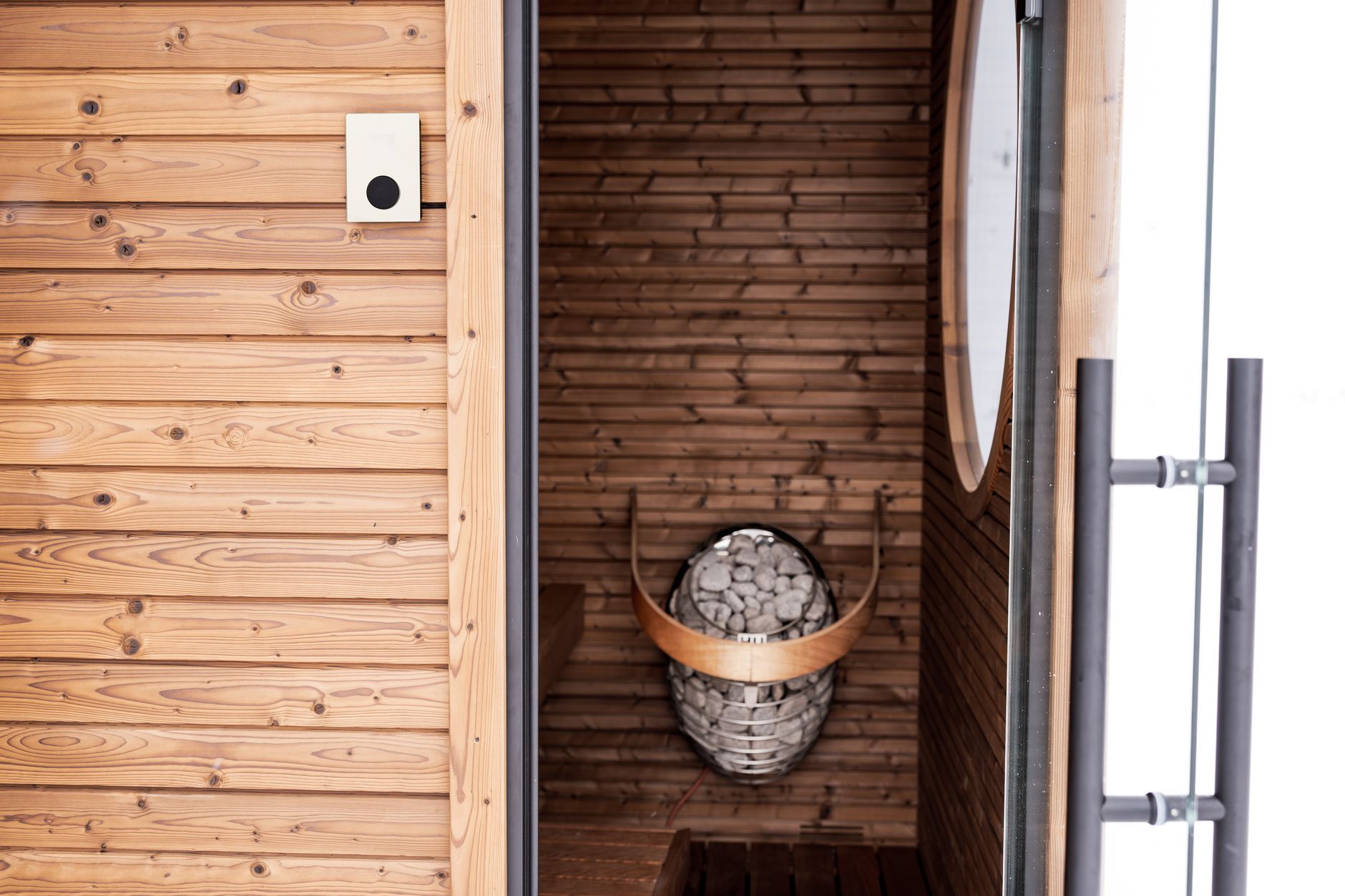
Indoor saunas offer convenience and year-round usability. You can sauna in a snowstorm without trudging through drifts. They're quieter, more controlled environments—which some people find meditative, others find claustrophobic. They're easier to use casually (late-night recovery session without bundling up). The downside: they can feel more "utilitarian" and less luxurious. And they don't offer the contrast therapy benefit of stepping into cold Vermont air.
Outdoor saunas are the luxury flex. There's something primal and restorative about sitting in 180-degree heat while snow falls around you, then stepping out into 20-degree air. The contrast is more intense—more effective for circulation—and the experience feels genuinely special. The downside is obvious: you're commuting through snow and cold to get there. Not everyone wants to do that at 10 p.m. in January.
What should you look for? Ideally, a cabin that offers both: an indoor sauna for convenient evening recovery sessions, and an outdoor sauna (or at minimum, easy access to outdoor contrast facilities like a cold shower or pool) for more intentional, deeper recovery work. If you're choosing one, prioritize based on your temperament. Are you someone who needs friction minimized to actually use recovery tools? Go indoor. Are you someone who thrives on the intensity and novelty of outdoor contrast therapy? Go outdoor.
Either way, verify the sauna's specifications. Look for saunas that reach at least 160 degrees Fahrenheit (authentic saunas operate 150-195°F). Check that it has proper ventilation and humidity control. Read reviews—people with experience using the sauna tend to leave detailed feedback. And if it's a dry sauna (traditional Finnish style), that's generally superior for the recovery mechanisms we discussed earlier.
Why Private Beats Shared
You could get a sauna experience at a luxury resort spa. Stratton Mountain, for instance, has excellent facilities. But there's a chasm of difference between scheduling a 50-minute sauna session at a hotel spa and owning one in your rental.
Private means no scheduling conflicts. It's 11 p.m., you've had two beers, you had an unexpectedly hard day on the slopes, and you want 45 minutes of heat and silence before bed. You don't need to check availability or reserve a time slot. You walk downstairs.
Private means no strangers. Recovery is psychologically easier when you're alone or with your group. You're not performing for anyone. You're not self-conscious about how much you're sweating or how you look in your swimsuit. You can sit in silence, or your crew can talk freely without concern for shared-space etiquette.
Private means flexibility. You want to do three short 15-minute sessions across the day instead of one long one? Fine. You want to throw a friend in there unannounced? Fine. You want to alternate between the sauna and the snow-covered porch without worrying about facility rules? Your rules now.
And practically: shared facilities mean germs, cleanliness variability, and the ambient stress of a commercial space. A private sauna in your rental is yours alone. You control the cleanliness. You control the temperature. You control everything.
This is why serious skiers prioritize private saunas. It's not just about luxury—it's about removing friction from the recovery process so that recovery actually happens.
Where to Find Vermont Cabins with Private Saunas Near Stratton Mountain
Stratton Mountain is Vermont's premier ski destination for good reason: consistent snow, excellent grooming, and proximity to charming towns like Manchester Center. If you're planning a Stratton-focused trip, you need accommodation that supports serious recovery.
The Stratton Chalet is purpose-built for this exact use case. A 3-bedroom luxury cabin situated minutes from the mountain, the Stratton Chalet features a private sauna, hot tub, and the kind of thoughtful details that turn a rental into a genuine recovery hub. After a day on Stratton's steeps and moguls, you're steps away from professional-grade recovery infrastructure. The sauna is indoor, meaning you can use it regardless of weather. The hot tub is right there for the cool-down phase. And the cabin's layout means you and your group have privacy and space to decompress properly.
If the Stratton Chalet is booked (or you're exploring other mountains), the Whispering Pines Lodge is another excellent option with sauna and hot tub amenities. Located with similar convenience to the mountain and local dining, it offers the same recovery-first philosophy.
Both properties are managed through Farandaway Homes, which specializes in luxury Vermont vacation rentals. If you're searching for other options, the team can help you identify cabins that meet your recovery requirements. Most Farandaway properties in the Stratton area come with sauna and hot tub infrastructure as standard—recovery is built into the offering.
Planning Your Ski Week Around Recovery
Having a private sauna changes how you should structure your ski week.
Day one: Moderate intensity. Arrive, settle in, acclimate to the mountain and your rental. Sauna use is light—more about exploration than recovery. Your muscles aren't yet demanding intervention.
Day two and three: Peak intensity. This is where you go hardest. Steep runs, moguls, tree skiing—whatever challenges you most. Sauna use should be 20-30 minutes post-ski, followed by contrast therapy (cold exposure) if available. These are the days your muscles need the most support.
Day four: Consider a lower-intensity day. Not an off-day, but something gentler. Cruising, lessons, exploring terrain you haven't skied yet. Use the sauna for 15-20 minutes in the evening as maintenance recovery. Your body is asking for consolidation, not intensity.
Day five and six: Ramp back up. You've recovered. Push again. Full sauna protocol after each day.
Day seven: Moderate intensity, full recovery focus. One last morning on the mountain, then serious sauna and hot tub time in the afternoon. You're prepping for the drive home.
The science behind this structure: sauna recovery is most effective after intense exercise, but it's cumulative. The more regularly you use it throughout the week, the more adaptation your body undergoes. By day six, your recovery systems are optimized. You're recovering faster than you would be without sauna access, which means you can ski harder without accumulated fatigue.
This is why skiers with private saunas often report doing more runs, skiing longer into the day, and feeling fresher at the end of the week than they expected. You're not just recovering—you're actively extending your capacity.
FAQ
Related reading
- Vermont Luxury Cabins with Private Pool, Hot Tub, and Sauna: What to Expect
- Luxury Vermont Cabins with Hot Tub & Sauna near Stratton
- Whispering Pines Lodge — Luxury Vermont Rental
Related guides for Vermont STR owners